Key Takeaways
- How2Recycle (H2R) is a labeling system that aims to standardize and clarify recycling instructions for consumers using on-pack labels.
- They use several criteria, including consistency with federal and state laws, to assess whether a package is recyclable and can be labeled as such.
- Various packaging components can affect a package’s technical recyclability, so further testing may be required.
- Packaging manufacturers may have their packaging pre-qualified under H2R, but ultimately, the users of the packaging, brands, must request and own the right to use the labels.
- California’s Truth in Labeling law, SB 343, has impacted H2R’s designation of various labels.
As the topic of recyclability of packaging continues to grow, so does the need for reliable and trustworthy labels to back up recyclability claims. This has become increasingly clear through the emergence of legislation like California’s Truth in Labeling Law, SB 343, that places restrictions around when brands can label products as recyclable. In this Deep Dive, we’ll talk about How2Recycle–the most recognized on-pack labeling system in North America–what they do, how their labeling system works, and how brands can best utilize their platform.
What is How2Recycle and why is it important?
Over the past decade, consumers have become more attentive to the environmental impacts of the products and packaging they buy, and far more skeptical of the systems in place to manage that impact. Headlines about recycling contamination, plastic pollution, and waste exports have eroded public confidence in our recycling system. As awareness grows, so does the demand for clarity. People don’t just want to purchase products that purport to come in recyclable packaging; they want to trust that the packaging is truly recyclable and will actually be recycled.
This growing sentiment has become increasingly apparent through several legislative developments, including packaging extended producer responsibility (EPR) laws being passed in multiple states, and California’s Truth in Labeling Law, SB 343. Packaging EPR laws aim to place the financial and operational responsibility of end-of-life treatment of packaging on the companies that produce it, while also incentivizing the production of more sustainable packaging formats. The legislation is also designed to use funds collected by producers to improve and expand recycling infrastructure. California’s Truth in Labeling Law, on the other hand, prohibits the use of recycling labels on products and packaging unless certain criteria are met. Together, these regulatory frameworks work to improve our waste management system while rebuilding consumer trust in recyclability claims.
While these legislative updates have only occurred in the last few years, the need for trustworthy labeling has been apparent for quite some time. In 2008, How2Recycle (H2R) was created as a project of the Sustainable Packaging Coalition (SPC) and its parent environmental 501(c)(3) nonprofit GreenBlue, after they identified the need for an accurate, consistent on-package labeling system. The project aimed to improve clarity for consumers on how to dispose of their packaging waste as well as to reduce greenwashing. H2R officially launched in 2012 and has since become the most recognized on-pack labeling system for disposal instructions, with over 800 members and thousands of certified SKUs.
What do How2Recycle Labels Look Like?
H2R exists to provide standardized, vetted, clear recycling labeling on packaging to help consumers understand whether and how to recycle an item. H2R is a membership-based labeling system; brand owners and retailers pay an annual flat fee that allows them to place one of the H2R labels on their products once they have been properly tested and vetted for recyclability.
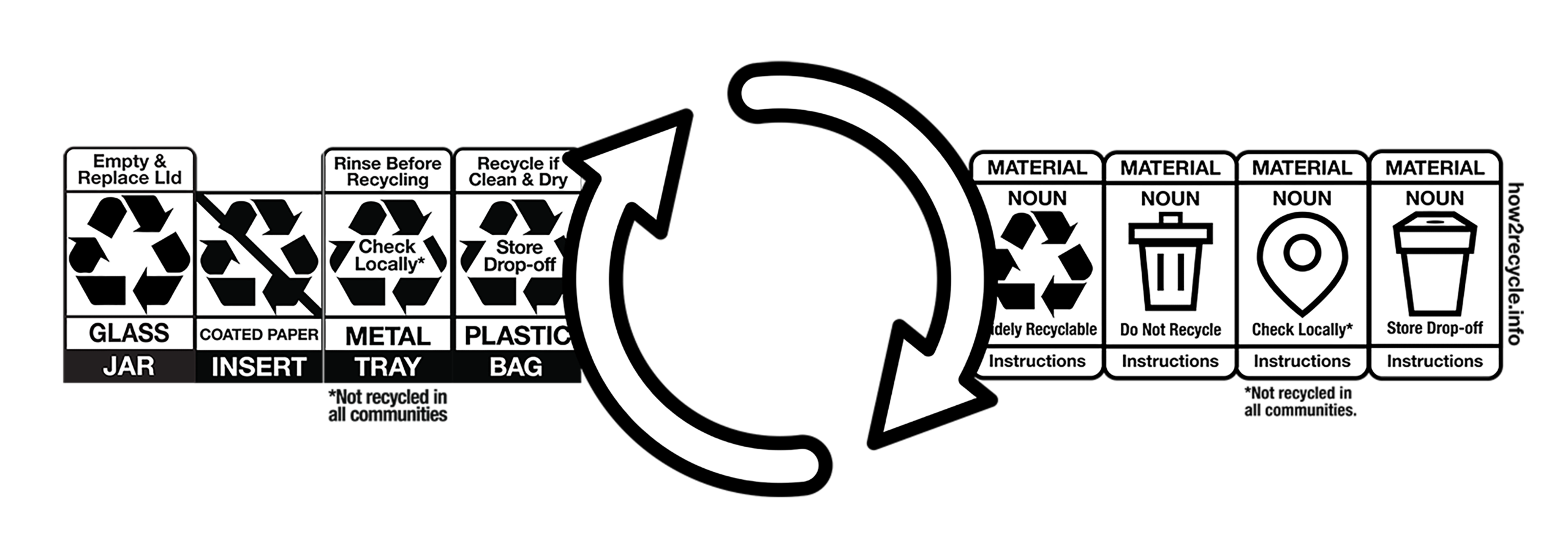
Because of their prevalence, you have likely seen these H2R labels on products before. On the left of the photo below, you’ll see H2R’s “Legacy Labels” that have been in use since H2R was launched. These labels contain a chasing arrows symbol in the middle, disposal instructions on top, and material classification on the bottom. Some labels also contain special instructions such as “Check Locally*” and “Store Drop-off.” We’ll go deeper into what these labels mean later.
On the right of the photo, you’ll see H2R’s new Pro labels. The transition of these labels was largely driven by the need to comply with policies like California’s Truth in Labeling Law, SB 343, in addition to a desire to make recycling even easier for consumers to understand and act on. As you can see, one of the biggest changes is that most of the labels have transitioned away from the chasing arrows symbol. This is because one of the major provisions of SB 343 prohibits packaging products from having labels that contain the chasing arrows symbol (even if it’s crossed out) unless they have been proven to be “widely recyclable.”
We’ll explain what it takes to qualify as “widely recyclable” later, but what you need to know now is that, in California, unless a product meets the state’s standards for recyclability, it can no longer be labeled with the chasing arrows symbol or the word “recyclable.” To comply with this, packaging materials that do not meet these standards will now be labeled with symbols and instructions that designate whether consumers should throw them away, take them to a store drop-off location, or check local guidelines for proper disposal. In addition to the change in symbols, all the new labels contain a material classification at the top and custom instructions for proper recycling at the bottom, such as removing certain components before discarding.
How does How2Recycle Assess Recyclability?
Each different packaging product that receives a H2R label undergoes an individualized recycling assessment based on detailed packaging specifications that the company provides through the member platform. Each assessment is based on the five pillars that make up the definition of recyclability: applicable law, collection, sortation, reprocessing, and end markets (see our deep dive on recyclability for more detailed explanation).
In terms of applicable law, the labeling system is designed to comply with legislation and guidance in the United States and Canada, such as the US Federal Trade Commission’s Guides for the Use of Environmental Marketing Claims (“Green Guides”) and the Competition Bureau Canada guidance. These guidelines lay out when it is legal to use terms such as “recyclable.” In addition to federal legislation, H2R has worked to adjust its system to comply with state laws. This has been especially necessary because of California’s Truth in Labeling Law, SB 343 – more on this below.
Once alignment with applicable law is confirmed, H2R then assesses the collection rate of that particular packaging format to validate that a certain packaging format is actually collected in practice. In the United States, H2R’s data for acceptance is largely informed by The Recycling Partnership’s National Recycling Database, which offers detailed, localized recycling information from over 9,000 unique community recycling programs across the U.S. This partnership allows H2R to receive timely information on the collection of specific material formats for recycling in the U.S., which helps inform the label eligibility of various packaging formats. In the U.S., if a packaging type is accepted by recycling programs that serve at least 60% of the population, it is considered widely recyclable under the collection criteria. For packaging types that are accepted by programs that only serve between 20%–60% of the population, they are limited to a “check locally” label. Any packaging formats that are accepted by programs that serve less than 20% of the population will automatically receive a “Not Yet Recyclable” label.
In addition to these three classifications is the option for store drop-off recycling. Store drop-off (SDO) recycling works to collect specific plastic materials that cannot be processed effectively in curbside recycling programs and provide an alternative collection system to reduce landfill waste and plastic pollution. In the U.S. SDO system, consumers bring clean, dry polyethylene-only plastic film items – such as grocery bags, bubble wrap, and shrink bundling film – to designated drop-off points. These drop-off points are typically found at retail and grocery stores that choose to participate in plastic film recycling programs. See our other deep dives for more information on SDO systems and when to use them.
To assess recyclability in Canada, H2R follows a similar methodology of looking at the acceptance by communities of specific packaging formats for recycling, but uses third-party data sources such as CM Consulting’s report Access to Residential Recycling of Packaging and Packaging Material in Canada. In Canada, packaging formats must reach at least 50% collection rates to be considered “Widely Recyclable,” between 20%–50% for “Check Locally,” and anything below that is considered “Not Yet Recyclable.” Another important distinction is that film packages that receive the “Store Drop-off” label in the US are considered Widely Recyclable in Canada. This means that you can recycle these film packages in your curbside or drop-off bins in Canada.
In addition to collection rates, H2R also considers how successfully materials are sorted in a Material Recovery Facility (MRF) based on things like size, shape, and other physical attributes. The more successfully a packaging format can be sorted within a MRF, the higher the likelihood that it will end up in a clean bale that can be sold to an end market and transformed into a new product. For more information on how the sortation process in these MRFs works, see our MRF Deep Dive.
Lastly, H2R takes into consideration what happens to these materials once they leave a MRF. For reprocessing, H2R considers how successfully materials are reprocessed by different entities. They consult experts and reference well-established industry guidance and testing protocols to understand the types of packaging materials that are actually able to be turned into new products. They also assess what end markets are available, considering demand, scale, and value over time to determine whether a material will be responsibly made into new products.
All of these different considerations come together to determine the right label for the product. In addition to providing labels, H2R identifies ways members can improve their package design by assigning an overall recyclability categories for each complete package they assess: optimally recyclable, recyclable but needs improvement, and partially recyclable or not yet recyclable. Packages that receive an “optimally recyclable” status meet all the criteria for best design practices in their material category, and do not need any improvements to increase recyclability. For packages that receive a “recyclable but needs improvement” status, the majority of the package or the whole package is recyclable, but it falls short of being “optimally recyclable” due to suboptimal features. Packages that receive a “partially recyclable or not yet recyclable” status contain one or more components that feature the “Check Locally” or “Not Yet Recyclable” label.
Packaging formats that fail to receive an “optimally recyclable” status will receive details from H2R on what issues are present and recommendations for how to improve them. When assessing the technical recyclability of plastic packages and making recommendations for optimal design, H2R relies heavily on their partnership with the Association of Plastic Recyclers (APR) and their Design Guide, APR Design Recognition Program, and testing protocols. For a plastic packaging format to receive an “optimally recyclable” status, all features of the package must be categorized as “Preferred” by APR. Because of this, H2R strongly recommends that companies pursue APR Design for Recyclability Recognition for all eligible plastic packages. While gaining APR Recognition does not guarantee a specific label will be assigned, it helps simplify the label request process and typically reduces the amount of information and testing that H2R requires on a label request.
Tests required for How2Recycle Approval
Before submitting a package for approval through the How2Recycle membership portal, it’s important to know that some packaging types may require additional testing to receive a more favorable recyclability label. Failure to go through these tests may result in the package receiving a conservative label (e.g., “Check Locally” rather than “Widely Recyclable,”) or H2R declining to provide a label at all. The most commonly required tests are for fiber-based packaging, PE film, and rigid plastics.
Some rigid and flexible fiber-based packaging may require technical recyclability testing to be eligible for a more favorable H2R label, and H2R may decline to label flexible paper innovations at all without testing. If a company’s package contains one or more of the following attributes, it is likely that H2R will require some form of testing: plastic laminates and coatings; foil and metallization; repulpable, sealable and other coatings; bagasse, bamboo, and other non-wood alternative fibers. This is not an exhaustive list of all the attributes that may lead to a testing requirement, but they are the most common.
If the fiber-based package requires testing, it will have to undergo the Fibre Box Association’s recyclability testing, which includes both Repulpability (Part 1) and Recyclability (Part 2) testing at a H2R partner lab. Part 1 assesses whether the fiber can break down into pulp, and Part 2 assess whether that repulped fiber can be made into new paper or board. Currently, partner labs are the University of Wisconsin Stevens-Point, Innofibre in Quebec, and Western Michigan University (WMU). Packaging must be tested as it would enter the recycling stream, meaning that the packaging must be in the same format (including all print and decoration) that it would be in when the consumer receives it. Unbleached fiber packaging must pass under OCC-E Protocol while bleached fiber must pass under SBS-E Protocol. Currently, WMU is the only approved lab for SBS-E paper testing.
PE films with any of the following attributes require testing to be eligible for a “Store Drop-off” label: metallized layers and metallic ink; unfilterable barrier layers (i.e., PP, nylon, and EVOH); barrier and innovative coatings (i.e., AIOx, SiOx, and PVOH); combination of multiple functional layers, barriers or coatings; cold seal adhesive; PP attachments (i.e., zippers and labels); and fillers or PE attachments causing the overall density of the structure to exceed 0.996 g/cm3. H2R requires the use of APR’s Critical Guidance Protocol for Polyethylene Films when testing is required to demonstrate a PE film structure’s compatibility with the PE recycling stream. Additionally, PE films may require APR’s Polyolefin Packaging Articles Sink or Float Evaluation when Critical Guidance testing is not required, but the film’s density is a concern. Keep in mind that even if they contain one of the listed attributes, some structures may not require testing if they have received APR Recognition or have been pre-qualified with H2R. We’ll talk more about what pre-qualification through H2R means later in this deep dive.
Rigid plastics with one of the following attributes may require testing to receive a favorable label: scavengers and oxygen ingress barriers; barriers (i.e., EVOH, nylon, AIOx, and SiOx); fillers and integrated desiccants; and functional additives, layers, and coatings. HDPE or PP containers with fillers or additives that increase the resin density to 0.97 – 1.0 g/cm3 require APR’s Polyolefin Packaging Articles Sink or Float Evaluation, which can be completed in-house. The other APR test protocols for rigid plastics include the Critical Guidance Protocol for HDPE Rigid Containers, Critical Guidance Protocol for PP Rigid Containers, and the Critical Guidance Protocol for Clear PET Resin and Molded Articles.
How to submit a product for approval through How2Recycle
In order to be eligible for a H2R label, a company must first be a H2R member. Membership fees vary depending on the company’s size, as well as whether it is a member of the Sustainable Packaging Coalition.
Once a company becomes a member, it is eligible to submit products for H2R approval and labels through the Membership Portal. H2R provides members with the option for pre-qualification letters or product labels. Pre-qualification letters are provided to material manufacturers and converters for eligible packages upon request. While pre-qualification does not guarantee a specific H2R label for finished products, it can help simplify the label request process for final products once they are ready for submission. Pre-qualification letters should only be requested for base materials (films, paper substrates, etc.) or complete, unbranded packages. Rather than serving as certificates, pre-qualification letters are designed to be used as guidance tools that help brands understand whether a package could be recyclable before investing in full packaging development.
Ultimately, the brand whose product goes into the packaging is usually the one to submit a request to use an H2R label, even if the material is pre-qualified. Recyclability labels are only given to finished products. When submitting a product for a label, the member enters detailed information about the packaging: brand/SKU context and full component specs (e.g., primary material and resin, layer structure, film type, closures, labels, inks, coatings, windows, adhesives, and any available test data). How2Recycle then evaluates the packaging against its Guidelines for Use and recyclability criteria, assigns the correct recyclability designation (Widely Recyclable, Check Locally, Store Drop-Off, or Not Yet Recyclable), and generates final artwork for the How2Recycle Pro label that the member can download from the platform and send to their packaging suppliers or printers.
Because label requests are structure-specific, brands generally need one label request per unique packaging structure, not per marketing SKU. If multiple SKUs use the exact same packaging format, materials, and components, they can typically share a single label request, but if there are meaningful structural differences that affect recyclability (e.g., different materials, closures, barriers, films, or added components), those versions require separate submissions. For example, a company may sell a full line of chips in different flavors, but because each flavor uses the same exact packaging structure with only a change in graphics, only one label request is needed.
How are H2R labels affected by California’s Truth in Labeling law?
In 2021, California passed SB 343, often called a “Truth in Labeling Law,” governing when it is legal to call an item “recyclable” and to use the “chasing arrows” recycling symbol. In short, to be eligible to use recyclability instructions and/or the chasing arrows symbol, SB 343 requires that a packaging type actually be accepted by at least 60% of statewide recycling systems. This means that some common packaging formats, such as flexible films, that are not commonly accepted by curbside programs, can no longer carry the word “recyclable” or the chasing arrows. In practice, SB 343 is enforceable as of October 4, 2026.
This change precipitated two major changes with H2R. First, it was one of the reasons that H2R evolved to the new Pro labels, which removed the chasing arrows from all labels except the “widely recyclable” label. Secondly, in response to CalRecycle’s Material Characterization Study (MCS) published in April 2025, H2R announced that it is downgrading several packaging formats from a “Widely Recyclable” status to a “Check Locally” status. The MCS provided data about collection access rates throughout California and found that certain packaging formats, such as some coated papers, do not reach a 60% access threshold.
What this means is packaging formats that do not qualify as recyclable under California’s law will no longer be eligible for a “Widely Recyclable” label within the H2R system. This protects H2R from issuing labels for products that could fail to comply with state legislation. Members can read the Supplementary Member Notice: California SB 343 Impacts on Labeling Eligibility in the H2R member portal for more information. The Atlantic sustainability team is also available for further discussion of this topic.
Conclusion
The How2Recycle system plays a vital role in today’s packaging landscape by bringing clarity, credibility, and consistency to recyclability claims—needs that have only grown with evolving consumer expectations and regulatory pressures. As described in this deep dive, the program’s structured label review process ensures that each package undergoes a detailed recyclability assessment based on material composition, collection access, sortation behavior, reprocessing pathways, and end-market viability. This rigorous evaluation helps brands avoid greenwashing while empowering consumers to make informed disposal decisions
Atlantic is a proud member of How2Recycle and leverages the platform to support our customers in designing packaging that meets today’s recyclability expectations while anticipating tomorrow’s regulatory requirements. Additionally, we can help customers interpret pre-qualification letters, prepare complete label requests, identify when additional testing is needed, and navigate structure-specific requirements to avoid unnecessary resubmissions.
Where to go from here?
- How2Recycle-Quick Reference
- Visit our library of all our Deep Dives articles here
- Check out our Sustainability Terms Glossary, where we’ll add key terms from each of our Deep Dives over time.
- Sign up for our Deep Dive LinkedIn Newsletter and get these articles delivered straight to your inbox every month.
- Bookmark these pages for future reference!