

Key Takeaways:
- Eco-modulation in packaging extended producer responsibility (EPR) programs allows states to adjust the fees that companies pay for packaging waste based on how sustainable or harmful that packaging material is.
- Colorado and Oregon have rolled out their EPR programs’ own eco-modulation systems, while California’s and other EPR states’ systems are still in development.
- Colorado’s eco-modulation program is comprised of two mechanisms: passive factors, which are applied automatically to material categories, and active factors, which require additional reporting from producers.
- Oregon’s eco-modulation program is comprised of three bonuses (A, B, and C), and each is dependent on the pursuit and disclosure of life cycle assessments (LCAs).
- California’s law, SB 54, mandates eco-modulation for nine different factors; however, CAA plans to roll out the programs for these factors over the next several years.
Extended Producer Responsibility (EPR) is a regulatory framework that shifts the cost and operational burden of managing packaging waste from municipalities and taxpayers onto the producers who put that packaging on the market. In a previous Deep Dive, Extended Producer Responsibility (EPR) for Packaging Explained, we briefly touched on the topic of eco-modulation and its role within packaging EPR systems. In this Deep Dive, we will explore this topic specifically, examining what eco-modulation actually means, how it has been implemented so far in Oregon, Colorado, and California, and what these programs mean for producers.
Eco-Modulation – What is it?
In their most basic form, packaging EPR programs would assign a single fee per pound for all packaging materials headed for disposal. Instead, eco-modulation is a regulatory approach that creates more nuance by assigning higher fees to more harmful materials and lower fees to more sustainable materials.
In eco-modulated packaging EPR systems, items that are more difficult or expensive to recycle typically carry higher fees than packaging items that are easily recyclable. How eco-modulation is actually implemented can look different depending on what each state’s EPR statute mandates. While some states simply have eco-modulated fee schedules that grant lower fees to recyclable materials and higher fees to more ‘problematic’ materials, other states have more robust eco-modulation programs that consider factors other than recyclability, and/or that require producers to take certain actions in order to receive reductions in fees.
This raises one of the more confusing aspects of what eco-modulation is. Eco-modulation refers to both of the following mechanisms:
- Base fees (i.e., those that appear on the fee schedule from the Producer Responsibility Organization) for each material differ for various materials based on their relative recyclability. These differences are felt “automatically” by producers as they submit supply reports and receive invoices since each material simply carries a different fee. We call these passive eco-modulation factors.
- There are additional bonuses (basically, discounts) that producers can apply for based on specific aspects of their packaging materials that they can substantiate are better than the status quo. We call these active eco-modulation factors since producers have to go to extra effort to apply for them above and beyond their annual supply reports.
So far, two of the seven states that have passed packaging EPR legislation have established their own fully fledged eco-modulation programs – Oregon and Colorado. In addition to having passive eco-modulated fee schedules, both states have created active bonus/malus systems that offer additional financial incentives for producers to transition to more sustainable packaging options. Let’s dive into what both of those programs entail.
Colorado’s Eco-Modulation Program
Colorado Passive Eco-Modulation Factors
Colorado’s eco-modulation program comprises both passive factors and active factors. Passive factors are automatically applied to producer invoices based on supply data, meaning that there is no additional action required by the producer. The PRO, Circular Action Alliance (CAA) will assign these bonuses and maluses based on the supply data a producer reports and apply them to the invoices sent out for that program year.
There are actually two sets of passive factors in the Colorado program: the differences in the base fees themselves, and then three potential built-in bonuses/maluses based on additional recyclability/recycling rate concerns.
In other words, even though Colorado’s fee schedule already assigns higher base fees to materials that are difficult to recycle, these passive factors are applied on top of the base fees to provide an even bigger financial incentive for producers to transition to more recyclable materials.
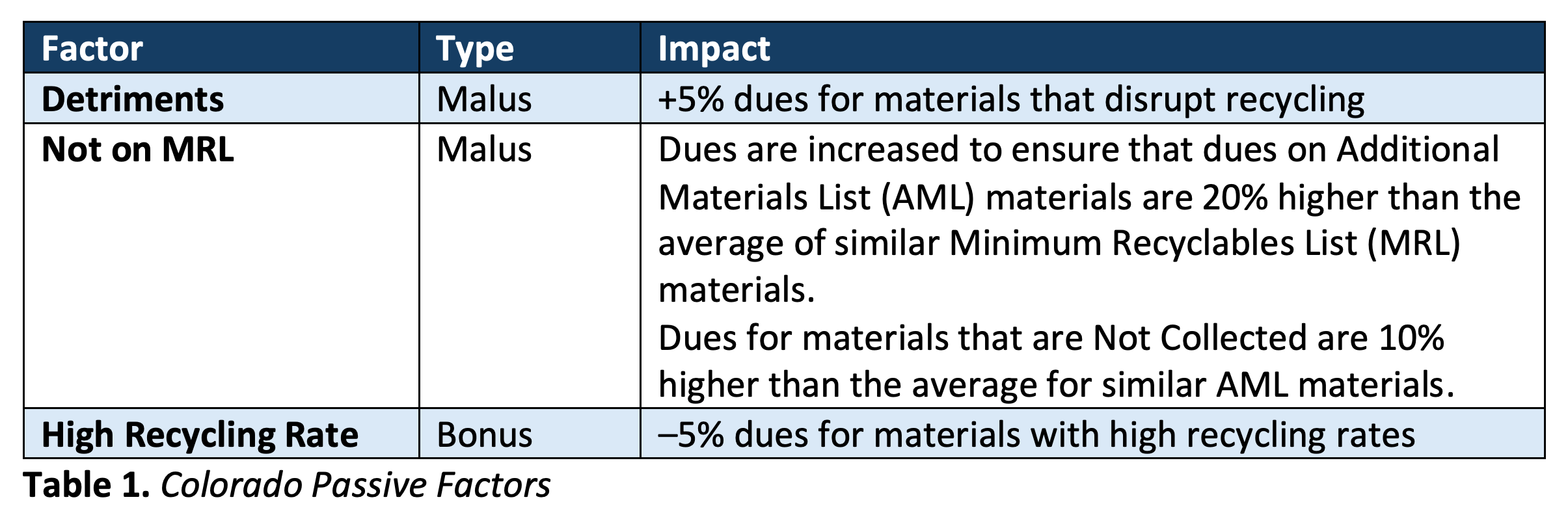
Within Colorado’s passive factors, there are two maluses and one bonus (see Table 1). The first malus factor, referred to as the “Detriments Factor,” automatically applies a 5% increase in dues for all materials that disrupt recycling. This determination is based on the Colorado Needs Assessment Evaluation, and the malus applies to any material category that:
(1) uses designs and practices that increase the cost of recycling, reusing, or composting covered materials, or
(2) uses designs and practices that disrupt the recycling of other materials.
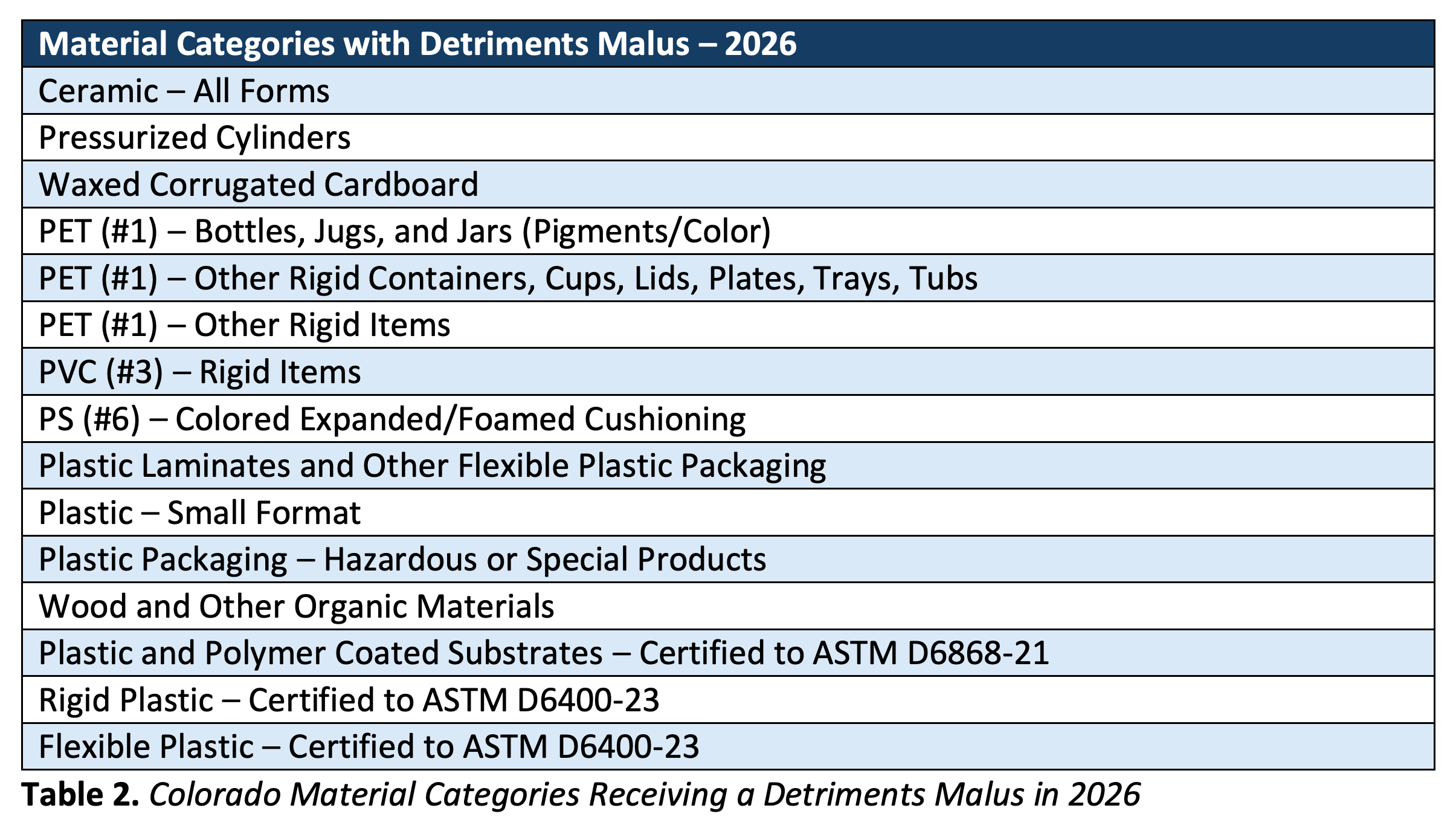
For example, if a covered material contaminates other recyclable streams, causes safety issues during sorting, or uses materials that are difficult to process in the stream, it may be deemed to be a detrimental material type. The material categories that will receive a detriments malus for 2026 are shown in Table 2 below.
The second malus is applied to all covered materials that fall on the Additional Materials List (AML) or the Not Collected List (NCL). The Additional Materials List (AML) is defined as covered materials not on the Minimum Recyclables List (MRL) that may be collected in different geographic areas through curbside services, drop-off centers, or other means. Not Collected materials are defined as any covered materials that aren’t on the MRL or the AML. CAA has stated that the AML, MRL, and NCL will be re-evaluated annually, and the status of material categories may change in response to changes to recyclability rates. Ultimately, producers want their materials to fall on the MRL if at all possible.
For this eco-modulation factor, rather than setting a flat fee rate, CAA will assess the dues after the detriments malus is applied to ensure that: (1) covered materials on the AML have dues that are at least 20% higher than the average of the base dues for similar materials on the MRL, and (2) covered materials that are Not Collected have dues that are 10% higher than the average of the base dues for similar materials on the AML. For example, the dues for a Paper/Fiber material on the AML or NCL will be compared to the average of the dues for all Paper/Fiber materials on the MRL, and eco-modulated to ensure that the dues are at least 20% higher for the AML, or 10% higher for the NCL.
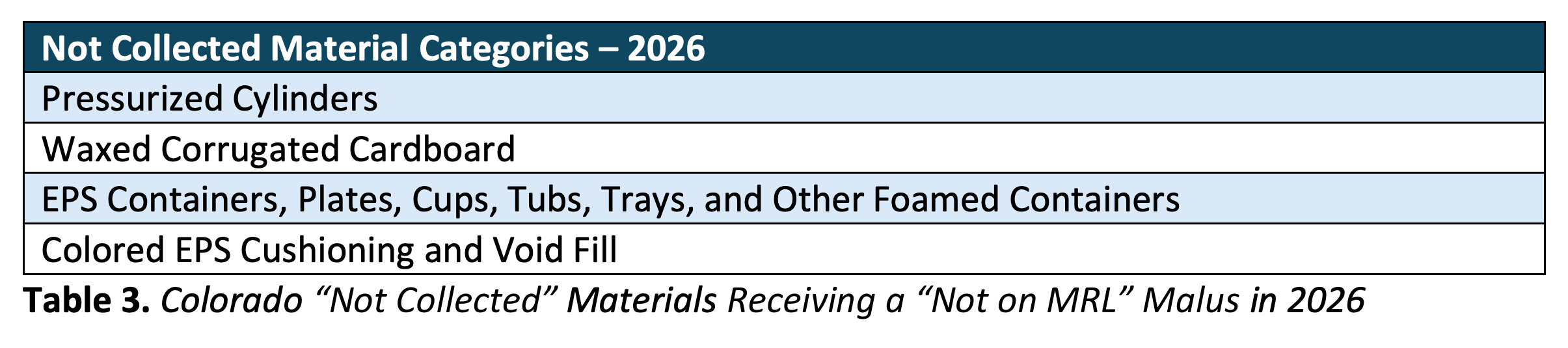
If the dues for the AML material are already at least 20% higher (or 10% higher for the Not Collected materials), then no additional malus will be applied. For 2026, because all AML dues were already greater than or equal to 20% above similar MRL materials, no AML materials received an additional malus. There are four material categories impacted by the Not on MRL malus because they are Not Collected (see Table 3). Each of these categories will have their fee rates eco-modulated to ensure that dues are 10% higher than the average of base dues for similar materials.
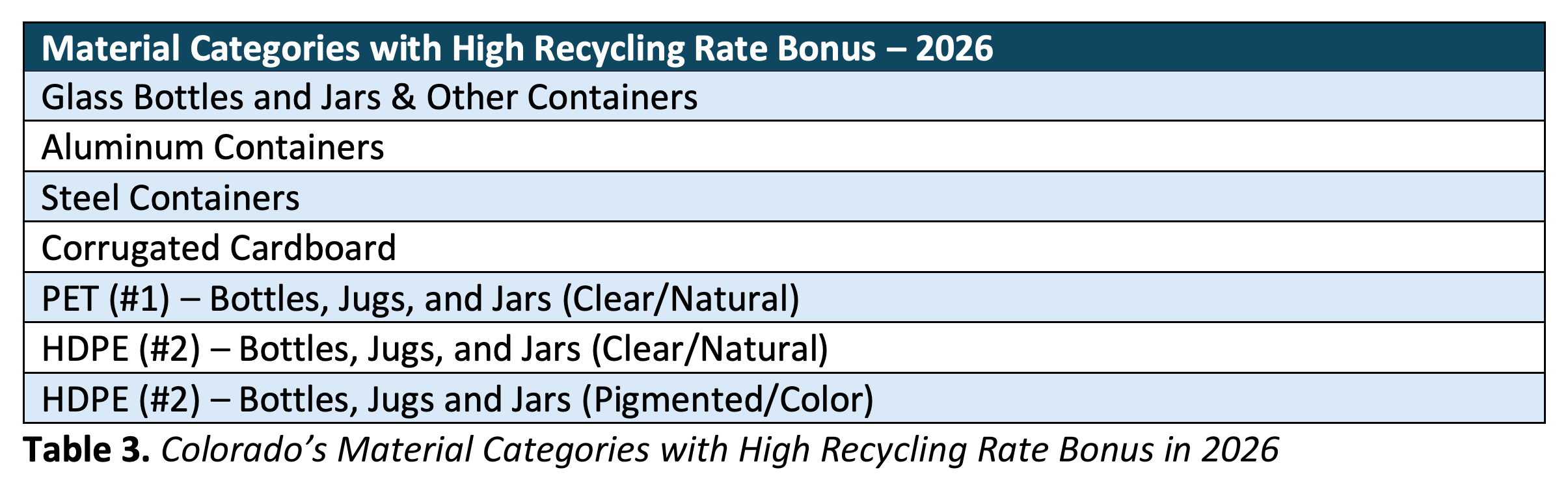
The last passive factor is a bonus given to materials that have high recycling rates. For the 2026 program year, a bonus will be applied that decreases base dues by 5% for material categories that are considered to have high recycling rates. Similar to the AML, MRL, and NCL material designations, this designation is based on the results of the Colorado Needs Assessment. To qualify for the High Recycling Rate Bonus, a material category must meet certain thresholds for availability of recycling services and collection infrastructure, recycling collection and processing infrastructure, and recycling end markets. Additionally, only materials with recycling rates that exceed the baseline recycling rate established in the Program Plan may qualify for the bonus. Table 3 shows the materials that will receive the High Recycling Rate Bonus for 2026.
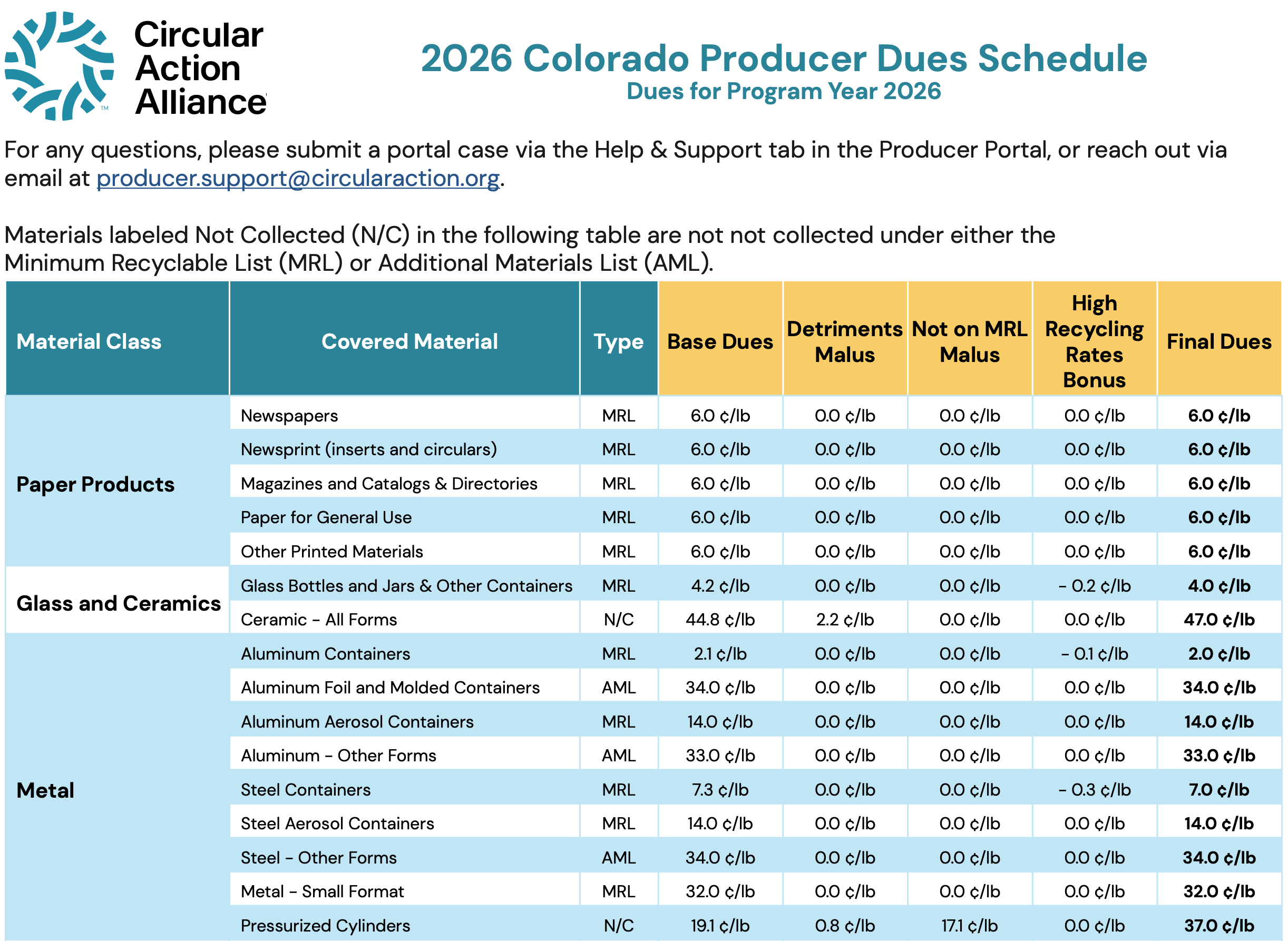
All four of these passive sets of factors can be seen on the Colorado Producer Dues Schedule (excerpt below; the full 2026 version is publicly available here). You can see that all materials have slightly different base dues. Among the other three columns, some materials carry them, while others don’t. The Final Dues reflect the sum of all four columns.
Colorado Active Eco-Modulation Factors
Now that we’ve covered Colorado’s passive eco-modulation factors, let’s look at the active factors. All producers who are considered to be in “Good Standing” in Colorado – meaning they’ve registered with CAA, reported their supply data, and paid all invoices that have been issued – may qualify to receive applicable active eco-modulation factors. However, unlike the passive factors, this process requires producers to submit additional data relevant to the specific factors. There are four active eco-modulation factors, and all of them provide financial bonuses to producers who qualify:
- Reduction Bonus
- Enhancement Bonus
- PCR Content Bonus
- Reuse/Refill Bonus
Reduction Bonus
The first active factor is the Reduction Bonus, which is granted when packaging or covered products achieve a weight reduction of at least 10%. In order to gain this bonus, producers must provide net unit weight data before and after the changes that resulted in the weight reduction. Producers who are able to prove this weight reduction will receive a 5% reduction in dues for relevant SKU quantities. The Reduction Bonus is a single-year bonus, but it can be granted for the same SKU or batch of SKUs every three years if further reductions are achieved.
Enhancement Bonus
The second active factor is the Enhancement Bonus, which is offered for improvements to covered materials that increase their commodity value or recyclability. To qualify for this bonus, producers must meet either the Material Enhancement or Design Enhancement threshold. Only one Enhancement Bonus is granted per producer for each SKU or SKU batch, even if both thresholds are achieved. Like the Reduction Bonus, producers who meet the requirements for the Enhancement Bonus will receive a 5% reduction in dues for relevant SKU or SKU batch quantities. Additionally, this bonus is also a single-year bonus, but it can be granted for the same SKU or SKU batch if it achieves a new enhancement. For example, a producer could implement a new design change to the same package to make it even more recyclable and become eligible for the bonus again.
To qualify under the Material Enhancement threshold, a producer must switch from a covered material that is Not Collected to a covered material that is listed on either the AML or MRL. The covered material’s reporting category must be different and more recyclable after the change, and the bonus only applies to the SKU component(s) that transitioned material categories, not to the full SKU weight and related dues. This packaging change must also have occurred within two data years of the supply data year to be eligible for the bonus. For example, if the supply data year is 2025 (reported in 2026), the design change would need to have happened after January 2023.
To qualify for the Design Enhancement threshold, a producer must implement a modification to a covered material that facilitates improved recovery or commodity value within Colorado’s recycling system. To provide more clarity around what this could look like, CAA offers a list of appropriate guides or third-party evaluations that producers can use to help guide these changes. The list includes but isn’t limited to:
- Association of Plastic Recyclers (APR) Design Guide: Under this guide, the Design Enhancement Bonus is granted if packaging component(s) go from a red status (Renders Package Non-Recyclable) or yellow status (Detrimental to Recycling) to a green status (APR Design Preferred).
- American Forest and Paper Association (AF&PA) Design Guidance for Recyclability: Under this guide, the Design Enhancement Bonus is granted if a packaging component moves from a grey/colorless designation to a green status. A grey/colorless designation means either “this non-fiber element is typically not found on this product” or “33% or more of respondents rated this non-fiber element as a challenge in mills.” A green status means “this non-fiber element does not adversely impact the recyclability of this item in mills.”
- The Aluminum Association Aluminum Container Design Guide: Under the guide, the Design Enhancement Bonus is granted if packaging component(s) meet one of the four keys as presented in the design guide:
- Key 1: Use aluminum
- Key 2: Make plastic removable
- Key 3: Avoid the addition of non-aluminum design elements whenever possible
- Key 4: Consider alternative technologies
- Can Manufacturers Institute (CMI) Steel Container Design Guide for Recyclability: The Design Enhancement Bonus is granted if packaging component(s) move from not meeting to meeting CMI recyclability guidelines. This applies to food cans, non-food cans, aerosol cans, and decorative tins, and includes minimizing tin, avoiding heavy metals in inks/paints, and using compressed gases where applicable.
In addition to these options, other certified third-party evaluations of improved recyclability may be provided by producers and approved by CAA. This may include certifications on previously uncertified packaging from organizations offering programs such as Western Michigan University’s repulpability and recyclability testing program, among others.
PCR Content Bonus
The third active factor is for post-consumer recycled (PCR) content. This bonus is granted for the portion of PCR content supplied in covered materials within a material category, provided that the PCR content rate threshold for that category is exceeded. Each material category maintains a different PCR content rate threshold, meaning that PCR incorporation is treated differently across material categories. For example, the PCR content rate threshold for corrugated cardboard is 85%, meaning that producers would have to use corrugated cardboard with at least 85% PCR to qualify for the bonus. In contrast, the PCR content rate threshold for flexible HDPE/LDPE film is only 15%, as it’s more difficult and less common to find high PCR rates in these items. The full list of PCR content rate thresholds is available in the Colorado Eco-Modulation Guidance, which registered producers can access through the CAA Producer Portal. For the 2026 program year, CAA has not required producers to provide additional PCR verification data as a condition for receiving the bonus; however, it has stated that it may do so in the future. For example, CAA is considering implementing a requirement for producers to verify that the PCR used is sourced from North America.
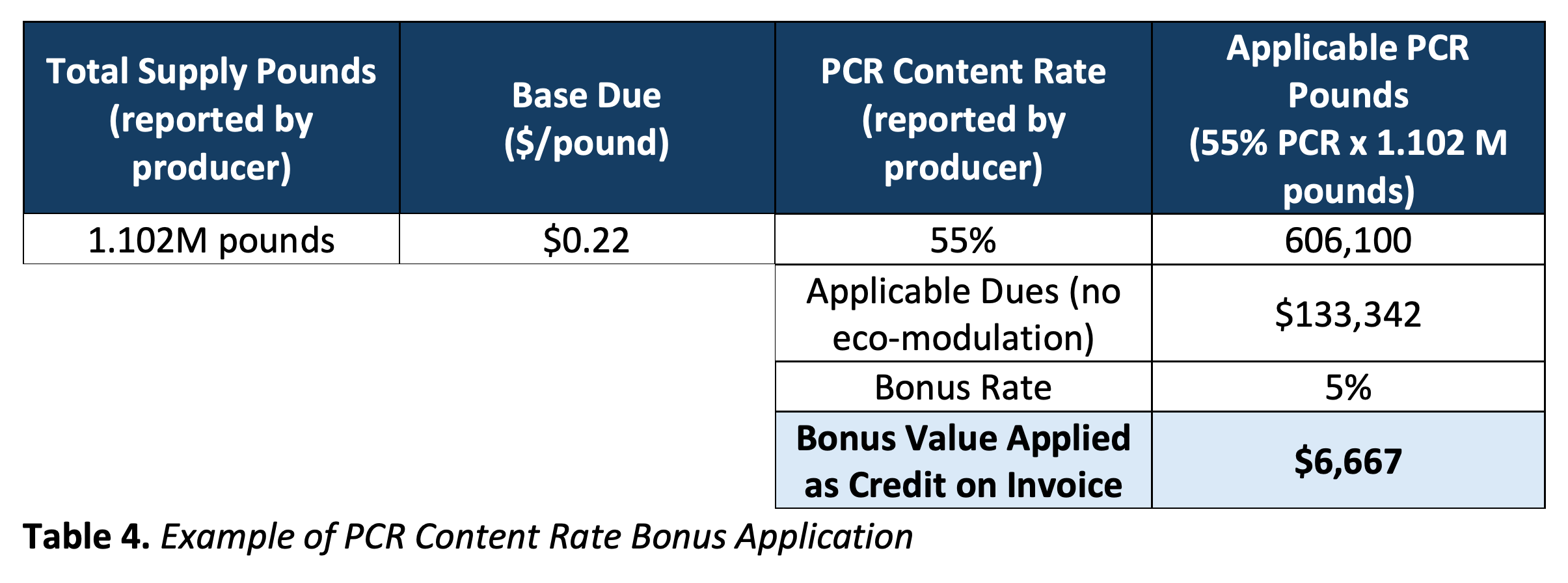
If a material category meets or exceeds the PCR content rate threshold, a 5% base dues reduction is applied to just the weight of the PCR material in the category – not all supplied tons. For example, imagine that a producer supplies 1.102 million pounds of newsprint into Colorado, and that newsprint contains 55% PCR content, exceeding the 50% PCR content threshold for that category. CAA would take the applicable dues for that 55% – multiplying the base due amount ($0.22/lb) by 55% of the total pounds supplied – and then apply a 5% bonus rate, resulting in a $6,667 credit that will be applied on the invoice.
Reuse/Refill Bonus
The last active factor is a Reuse/Refill Bonus. This bonus is applicable to MRL or AML-covered materials only and is granted to packaging that is designed for “refill-at-home” reuse models. In “refill-at-home” models, consumers refill a reusable container at home, referred to as the “parent packaging,” using refills delivered via another packaging component, referred to as the “child packaging.” For example, a producer may sell a home cleaning solution that comes in a spray bottle (the parent packaging), and they also offer a large refill jug container to allow for refill at home (the child packaging).
In order to qualify for the bonus, producers must report packaging designations, parent/child SKU details, and package pairing validation, including an attestation of functional dependency, consumer use, and labeling. Producers who meet these qualifications will receive a 5% reduction in dues for the relevant child packaging SKU quantities and applicable parent packaging SKU quantities. One constraint worth noting is that the bonus only applies to the portion of parent packaging units that the reported child packaging volume can actually fill, not the full parent packaging count.
Let’s take a look at an example. Imagine that a producer supplies 10,000 child packaging units in the form of household cleaning refill bottles into Colorado. Each of these refill bottles holds 60 fluid ounces, resulting in 600,000 fluid ounces of product entering the state. The same producer supplies 80,000 parent packaging units in the form of household cleaning spray bottles. Each of these spray bottles can hold 12 fluid ounces. If you divide the total volume of cleaning solution entering the state (600,000 ounces) by the parent container volume (12 ounces), the cleaning solution will only be able to fill 50,000 of the 80,000 bottles. Thus, the bonus will only be applied to the weight of 50,000 parent bottles, not the full 80,000.
There is one more constraint around all the active bonuses in Colorado worth mentioning – for the 2026 program year, the total eco-modulated bonus available to a producer for all active factors shall not exceed $50,000. However, CAA guarantees a combined minimum total eco-modulated bonus of $5,000 for granted active bonuses, or a bonus equal to the company’s total contribution if that contribution is less than $5,000. Because active bonuses require producers to submit extra documentation, CAA built in a floor to make that effort worthwhile even for a producer whose calculated active bonus would otherwise come out small. If a producer’s calculated bonuses only add up to a value less than $5,000 (say, $1,500), CAA will give the producer the full $5,000 bonus credit. However, if a producer’s total EPR dues amount to less than $5,000, CAA will pay the producer up to total invoice value, meaning the bonus can zero out their dues, but CAA won’t pay more than they owed in the first place.
Oregon’s Eco-Modulation Program
Like Colorado’s eco-modulation program, Oregon’s producer fee schedule features passive eco-modulated fees in which the base fees vary because of the recyclability of each material.
Unlike Colorado’s eco-modulation program with other various passive and active bonuses and maluses, Oregon’s eco-modulation system revolves around active bonuses stemming from improved sustainability and disclosures demonstrated through Life Cycle Assessments (LCAs).
The program is broken down into three distinct bonuses: Bonus A, Bonus B, and Bonus C. Bonus A is the simplest to achieve and is granted to producers that voluntarily evaluate and disclose LCAs for covered products used for up to 10 SKUs, or 10 batches of SKUs. These LCAs must follow the Lifecycle Evaluation (LCE) methods and standards set by Oregon’s Department of Environmental Quality (DEQ). This means that producers can perform LCAs for individual product SKUs, or they can batch similar SKUs into one LCA report, as long as the SKUs are part of the same product category and use the same types of primary covered packaging materials.
For this bonus, all that is required is the completion of an LCA; no improvements to the emissions or waste footprint caused by the material must be demonstrated. As part of this LCA, producers are required to calculate and disclose 16 distinct environmental impact categories, including climate change, water use, and others. However, because Bonus A has no performance threshold, producers are not required to show any improvement across these categories, nor are the categories combined into any kind of overall score. As long as the LCA is completed and verified in accordance with DEQ’s methodology, the SKU(s) will qualify for the bonus regardless of what the results show.
For each LCA completed – again, up to 10 SKUs or SKU batches – producers can receive a bonus of 10% of the total base fees for the covered SKUs. However, Bonus A will be capped at $20,000 for each LCA disclosed. For a producer to be eligible for any of the bonuses, including Bonus A, they must submit the following documentation:
- An LCA project report that includes a detailed identification of the SKUs or SKU batch. Producers will publish two versions – a confidential version and a redacted public report version that will be made available on CAA’s website.
- Proof that the SKUs under evaluation were in the Oregon market for at least one year prior to report submission.
- Weights for each material category that is represented by the SKU(s) in the report.
- Completed and verified LCA project reports in accordance with the standards and methods in the LCE rules. Producers may see the LCE rules in Oregon’s eco-modulation Guidance in the CAA Producer Portal.
- Completed and signed critical review report as part of the LCA report.
- An Excel file for Bonus Supply Volumes for bonus calculations.
- An Excel file for Bonus Impact Assessments.
Bonus B is granted to producers who voluntarily conduct an LCA, and through that LCA, demonstrate substantial impact reductions from a packaging improvement or change. Like Bonus A, Bonus B can be granted to LCAs used for up to 10 SKUs or SKU batches, and an LCA may represent one SKU or all of the SKUs included in the batch. Bonus B is set at up to 30% of the base fees for the SKU(s) covered by an LCA, intentionally set higher than Bonus A to encourage producers to make meaningful changes to their packaging. Because either one SKU or two SKUs may be reported — one representing the original packaging design, and the redesigned version that achieved the impact reduction — CAA uses only the volumes and fees of the resulting SKU (the new design) for bonus calculations.
To qualify for Bonus B, producers must calculate and disclose 18 environmental impact categories in total; 15 of these are combined into a single weighted score that determines the tier (and therefore the bonus), while the remaining three — human toxicity–cancer; human toxicity–non-cancer; and freshwater ecotoxicity — are reported separately and are instead subject to their own pass/fail limits. No single category can qualify a producer for the bonus on its own; it’s the aggregated result across all 15 categories, comparing the packaging before and after a producer’s change, that must show at least a 10% reduction from the original packaging format.
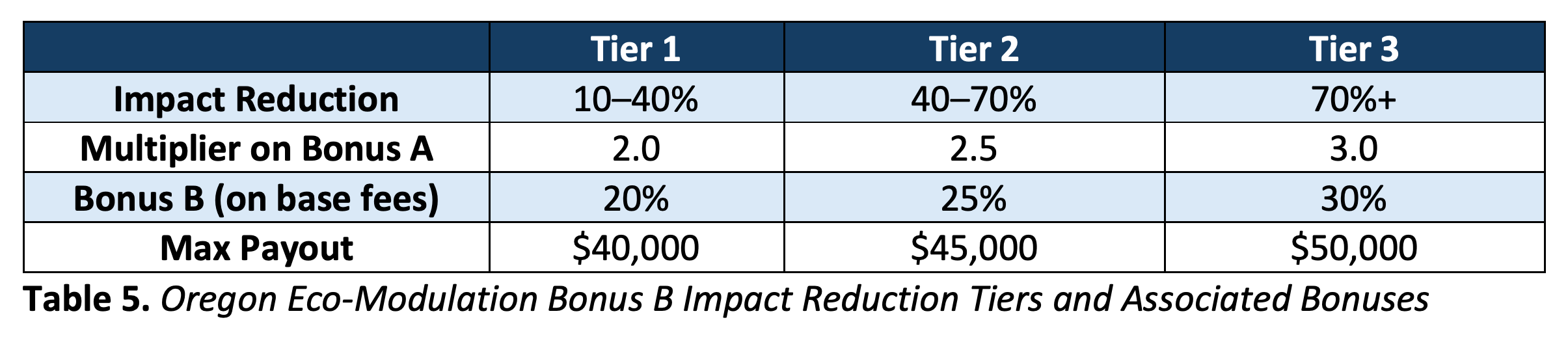
Let’s look at an example. Imagine that a company that sells laundry detergent chooses to make a packaging switch for their detergent pods, moving from an HDPE container with a PP cap and PE label to an HDPE film pouch. Let’s say that this move resulted in an 82% reduction in material weight and that the LCA demonstrated a dramatic reduction across several impact categories where the resulting weight score across the 15 categories was 71% reduction in impact. That producer would be eligible for a Tier 3 multiplier for Bonus A. This means that CAA will take the resulting packaging SKU’s – in this case the HDPE film pouch – volume and fees and apply a 30% reduction to the base fees (see the tier table below).
Bonus B is capped up to $50,000 for each LCA report covering one or multiple SKUs, depending on the tier of impact reduction received. This means that changes to the packaging that result in higher impact reductions will be eligible for higher bonuses. CAA has set the bonus levels and caps to ensure that the total bonus amount of Bonus B will always exceed those of Bonus A, in an effort to offer extra incentives to producers for making improvements to their packaging. Table 5 below displays the three possible impact reduction tiers and their associated bonus percentages.
Lastly, we have Bonus C, which is granted to producers who voluntarily conduct an LCA and demonstrate substantial impact reductions achieved by switching from a single-use package to a reusable or refillable packaging format. This bonus is explicitly designed to promote investment in reuse/refill programs to reduce environmental impacts relative to single-use packaging alternatives, and reward producers who do so successfully. Similar to Bonuses A and B, producers can receive Bonus C for up to 10 SKUs or SKU batches.
Bonus C uses the same impact category and scoring methodology as Bonus B (18 environmental impact categories are calculated and disclosed, 15 of which are combined into a weighted score to determine the tier and bonus amount). The key difference is what is being compared. For Bonus C, the “before” and “after” packaging designs specifically represent a switch from single-use to reusable or refillable formats.
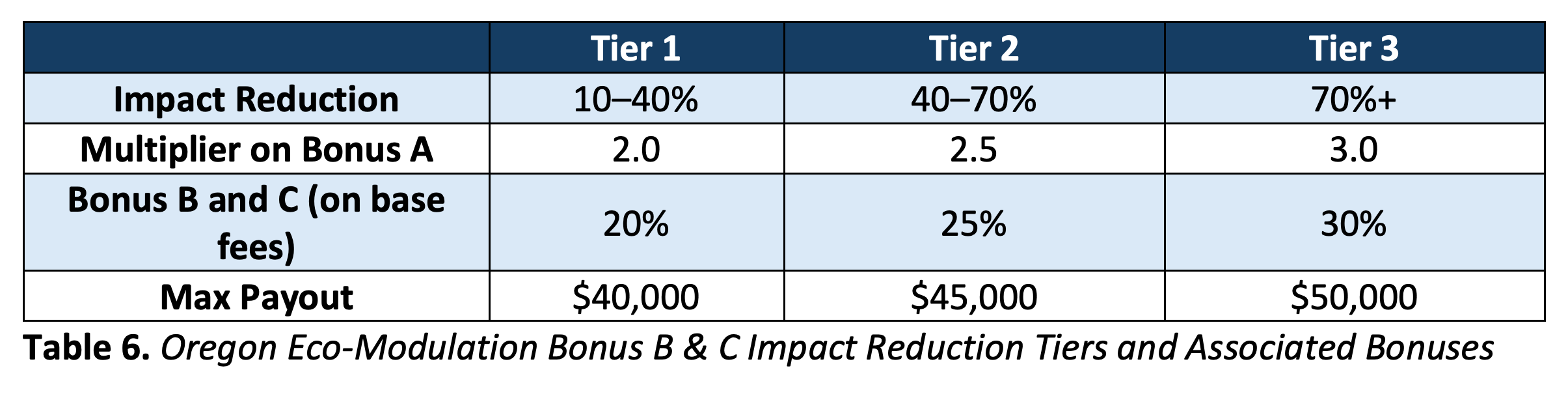
Following Bonus B’s model, Bonus C is set at up to 30% of total base fees for the SKU(s) covered by an LCA. As with Bonus B, when a producer reports both the original and redesigned SKU, only the volumes and fees of the resulting (redesigned) SKU are used for bonus calculations. For example, if a company switches from a single-use soap dispenser to a refillable soap dispenser and accompanying refill bottle, the volumes and fees of the refillable soap dispenser and refill bottle will receive the bonus. Also similar to Bonus B, Bonus C will be capped at $50,000 for each LCA report covering one or multiple SKUs, depending on the tier of impact reduction received (see Table 6 below).
There are three pathways through which producers can become eligible for Bonus C, and each is treated slightly differently:
- Switching from single-use packaging to reusable packaging using projected return rates
- Switching from single-use packaging to reusable packaging using actual return rates
- Switching from single-use packaging to refillable packaging using actual return rates
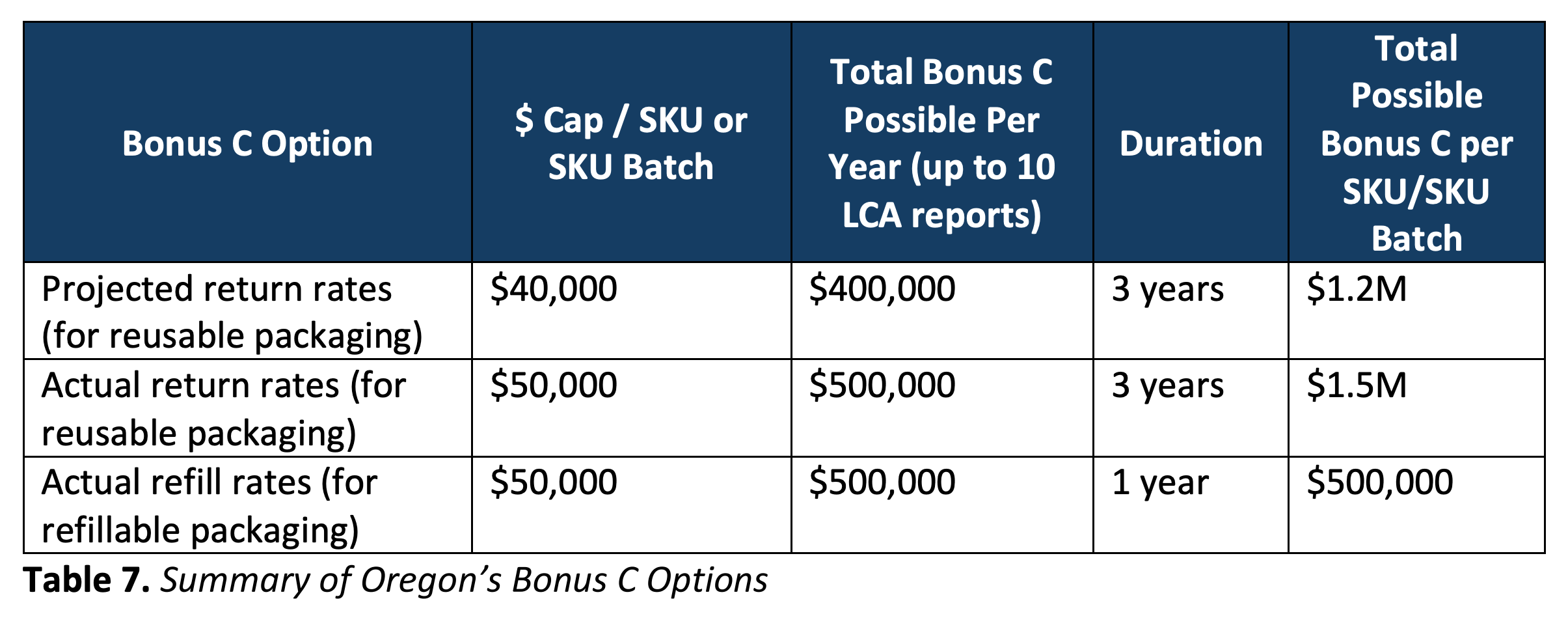
Producers who select the first pathway – switching to reusable packaging using projected return rates – will receive a three-year grace period within which producers may use projected return rates, after which actual return rates must be reported. Producers who choose this route must provide rationale for such projections in determining the environmental impact of their reusable packaging product. Under this option, Bonus C is equivalent to a Tier 1 impact reduction only, which is set to 2.0 times higher than Bonus A (or 20% of the base fees for that material), up to a cap of $40,000 for the SKU or SKU batch. The bonus award for the SKU(s) once approved will be granted each year for three years – with no change to the approved bonus amount determined in Year 1 – as long as the eligibility and reporting conditions continue to be met within that time frame. After the third year, a new LCA and application may be filed for the same SKU(s) to be reconsidered for Bonus C using actual return rates.
Producers who select the second pathway – switching to reusable packaging using actual return rates – will measure and report actual return rates during the three-year bonus period. Producers are expected to provide proof for the determination of their return rates, demonstrating how they are able to exceed the break-even point of their single-use packaging and reduce impacts by at least 10% via sensitivity analysis. If producers are able to measure and report actual return rates that meet or surpass their single-use packaging break-even point, producers will be granted Bonus C, which is set to at least 2.0 higher than Bonus A, up to a cap of $50,000 for the SKU(s). Similar to the first pathway, as long as eligibility conditions continue to be met, there will be no changes to the approved bonus amount determined in Year 1, and after the third year, a new LCA and application may be filed for the same SKU(s) to be reconsidered for Bonus C using actual return rates.
Lastly, producers may also select the third pathway, which involves switching to refillable packaging using actual return rates. Unlike for reusable packaging, there is no grace period for refillable packaging in which producers can submit projected refill rates. This means that producers must measure and report actual refill rates to be eligible for the bonus each year. This bonus is set to at least 2.0 times higher than Bonus A, up to a cap of $50,000 for each SKU. As refillable packaging systems may include multiple SKUs (e.g., a large bulk refill container and a smaller refillable container), bonuses will be paid based on the proportion of relevant SKUs substantiated by producers as part of the refill packaging system. Unlike the reusable packaging pathways, Bonus C is a one-time, one-year bonus for refillable packaging SKUs. However, producers can reapply for bonuses for those specific SKUs every three years, provided substantial environmental impact reductions are achieved.
Between the three pathways – as up to 10 LCA reports may be submitted for Bonus C – the maximum amount of Bonus C payments could reach $400,000–$500,000. Because the reusable packaging bonuses are three-year bonuses, producers could earn over $1 million in bonus payments across those three years.
Before we wrap up Oregon, there are several rules and constraints around Oregon’s bonuses that are worth mentioning. First, for each bonus, producers must be considered compliant and in “Good Standing,” meaning they have registered, reported, and paid all dues in Oregon, and have no remaining balances. Additionally, although LCAs are inclusive of covered product packaging across primary, secondary, and tertiary forms, only primary packaging is currently eligible for the bonus. In other words, although producers must model the full packaging system in the life cycle assessment, the resulting fee credit only gets applied to the primary packaging portion of what’s disclosed. This could change over time, but right now CAA wants to focus on primary packaging.
One caveat here – the Bonus C guidance suggests that secondary and tertiary packaging can become bonus-eligible if the producer can demonstrate that (1) they are actually making the packaging design decisions for that secondary/tertiary packaging (rather than it being determined somewhere else in the supply chain) and (2) it isn’t already being claimed under a separate dues exemption.
Another big constraint is that although producers can submit LCAs for up to 10 SKUs or SKU-batches per bonus type per year, a given SKU can only earn one of the bonuses (A, B, or C) in a given year. This means that if a producer pursues an LCA for a given packaging SKU and proves that impact reductions have been made, that SKU would only be eligible for Bonus B or C (depending on how those reductions were achieved), and would not also receive the Bonus A fee reductions on top of the Bonus B/C. Additionally, for all of the bonuses, LCA evaluations must have started no earlier than one year prior to submission to CAA to receive bonus credit, and total bonus incentives cannot exceed a producer’s total payable base fees.
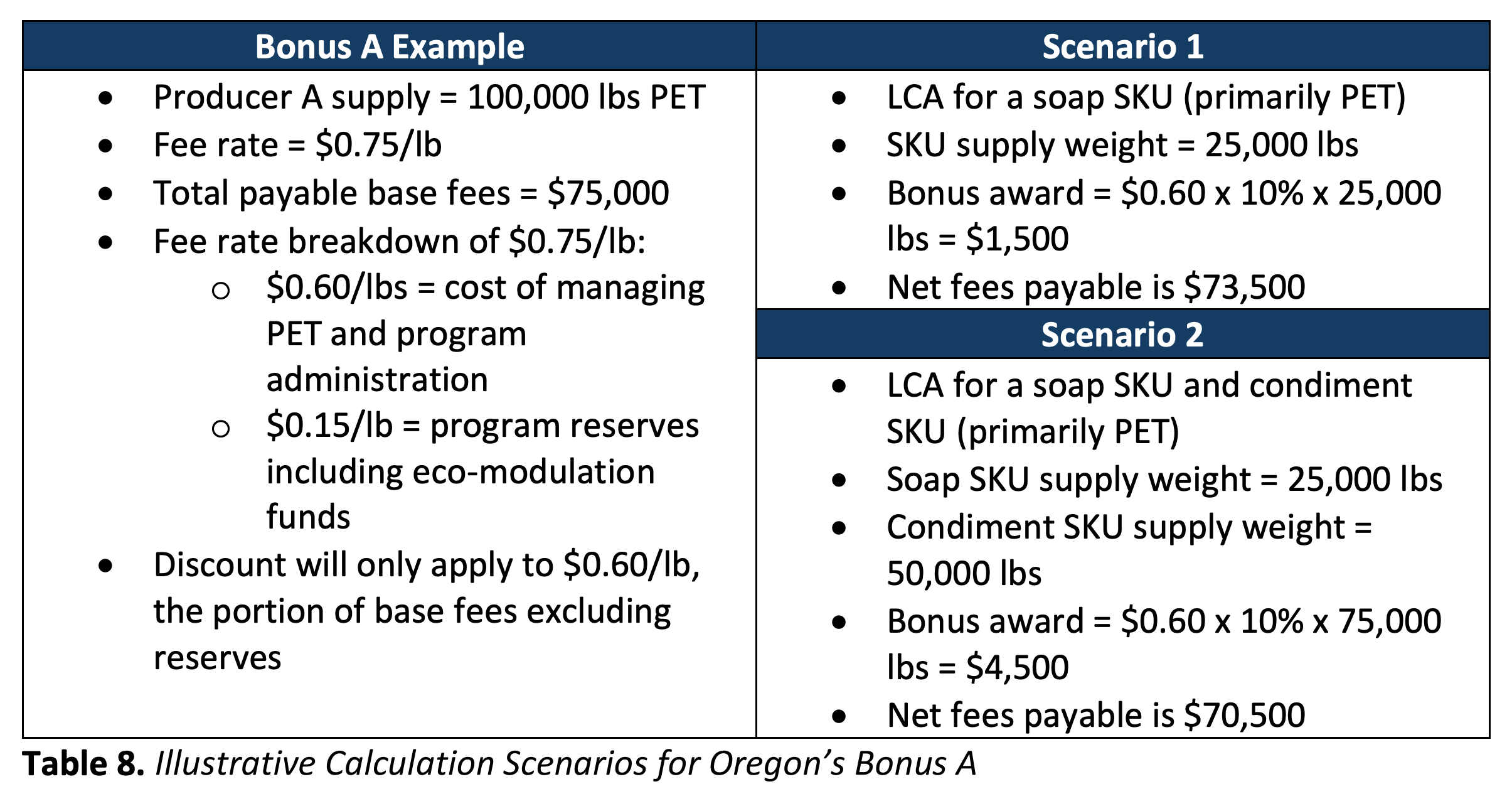
Lastly, each of the bonus amounts (e.g., 10% for Bonus A) will be set against the base fee for that material type, excluding the portion set aside for program reserves. What this means is that within each material category base fee, there is a portion that is dedicated for covering the cost of managing that particular material and program administration, and a portion that is dedicated to funding the bonuses for that particular material. The bonus fee will only be set against the portion of the base fee dedicated to covering the cost of managing the material (see Table 8 below). To our knowledge, CAA has not published breakdowns for each material category showing what percentage of the base fees goes towards material management/program administration, as opposed to what percentage goes towards program reserves (including eco-modulation funds).
California Eco-Modulation – What We Know, and What We Don’t Know…
Lastly, let’s look at California. SB 54, California’s packaging EPR law, uses a basic passive eco-modulation structure in the base fees, similar to Oregon and Colorado. Additionally, it mandates nine eco-modulation factors, but CAA’s draft Program Plan from June 2026 explains that it plans to operationalize them on a multi-year rollout that runs through 2029 and beyond. Because this program is younger than Colorado’s or Oregon’s, there is a lot that CAA is still figuring out on the ground, leaving many more “unknowns.”
Let’s start with what we do know. SB 54’s statute requires producer fees to be adjusted via bonuses and maluses on nine different factors:
- PCR Content
- Source Reduction/Right-Sizing
- Packaging Standardization
- Compliant Disposal/Recycling Labeling
- Accelerating Source Reduction and Reuse/Refill Investment
- Renewable-Derived Plastic
- Certified Compostable Without Toxic Additives
- Presence of Hazardous Materials
- Presence of Toxic Heavy Metals/Pathogens/Additives
Like in Colorado, CAA has two mechanisms through which they can implement these eco-modulation factors: active bonuses, which producers must apply for with documentation, and passive bonuses and maluses which are automatically applied at the material-category level. For example, there are several maluses applied to the weight and number of plastic components built directly into the Illustrative Fee Schedules that CAA released in mid-2026.
In terms of limitations and guardrails to California’s eco-modulation program, we also know a few things. First, CAA can’t impose requirements that conflict with federal tamper-evident, child-resistant, or food-safety packaging law. Second, total bonus incentives cannot exceed a producer’s total payable base fees. We’ve seen the last idea in both Colorado and Oregon, so this isn’t anything new.
Let’s look at the timeline for California’s eco-modulation program, and what we currently know about when bonuses and maluses will be rolled out. In 2027, the first program year, we know the following bonuses and maluses will be in place:
- A passive bonus for high-recycling-rate material categories
- A passive malus for categories not on the SB 54/SB343 recyclable-or-compostable list
- A per-pound active bonus for PCR content (all PCR must be APR-certified to receive the bonus)
- An active two-tier source reduction bonus;
- An active reuse bonus (see our California Source Reduction Deep Dive for information on these final three bullets).
Looking forward to 2028, we know that there will be a new malus for specific “problematic packaging features” (e.g., labels, adhesives, coatings) that will start at around 10% and scale up to a full 100%, effectively doubling the base fee over time. This target-feature list is supposed to be published annually alongside the fee schedule. We’re also expecting to see fee increases for materials that are harder to recycle or compost due to detrimental elements pushed from 2027 to 2028.
Looking at 2029 and beyond, the draft Program Plan makes clear that some bonuses and maluses have yet to be designed. Thus, we naturally have less insight into what these incentives or disincentives will actually look like on the ground. The bonuses and maluses that we won’t see enter the picture until 2029 or later include:
- Malus for Hazardous/Toxic Additives
- Bonus for Renewable-Derived Plastic
- Bonus for Standardization of Packaging
- Bonus for Labeling/Disposal Instruction
- Bonus for Certified Compostable Without Toxic Additives
Let’s look at a few more things we still don’t know. First, no actual dollar or percentage bonus/malus rates exist yet for anything. California’s Illustrative Fee Schedule has provided us with a general range for the 2027 bonus and malus amounts, but even these factors won’t have final rates published until October. Additionally, no criteria have been developed yet for the bonuses and maluses listed above, and the specific “problematic features” targeted by the 2028 malus have not been disclosed. An interesting thing to note is that nearly all of the eco-modulation factors rolling out for 2027 (e.g., PCR bonus, tiered source-reduction bonus) are explicitly scoped to plastic covered materials only. Whether this will continue to be true for the factors rolled out in the future is still unknown. We will continue to update this Deep Dive as more information becomes available.
Conclusion
Eco-modulation is a mechanism that allows packaging EPR programs to do what they’ve been designed to do more effectively – incentivize producers to move away from hard-to-recycle materials, and to prioritize the use of sustainable packaging materials. Eco-modulation can take many forms, which we can see from the different ways that Colorado, Oregon, and California have approached it. As these programs continue to roll out and develop further, producers should be using this information to help inform their strategies for packaging improvement, focusing on overlapping incentives such as PCR use, material reduction, and investment in reuse/refill systems where applicable.